Thursday, February 25, 2016

INTRODUCTION TO ACOUSTICS WAVE


Time and Frequency

Any periodic motion has a frequency. For example, we might say there are 60 cycles per second. This means that if we observe a time interval of one second, we would see 60 cycles occurring. However, it is not always practical to watch exactly one second and count the number of cycles.

Instead, we can measure the time duration of a single cycle and then calculate the frequency. Conversely, if the frequency is already known, we can determine the time period for one cycle. Time and frequency are reciprocals of one another. For instance, if 60 cycles happen in one second, dividing 1 by 60 gives the time period for one cycle. Likewise, to find the frequency from the time period of one cycle, divide 1 by that time period.


If 60 cycles occur in one second, the time period for one cycle is 0.0167 seconds. This relationship can be verified using the formula f×τ=1, or 60×0.0167=1. It is important to note that for any frequency above 1 Hz, the time period for one cycle will be less than one second. Additionally, if frequency is expressed in cycles per second, then time must be measured in seconds.

Frequency

Frequency is defined as the number of cycles that occur within a given time period, typically one second. Until a few years ago, frequency was referred to as cycles per second (cps). The term cps was later changed to hertz (Hz) in honor of the person who developed the theory of frequency. Machine speed is often measured in revolutions per minute (RPM), but the frequencies generated by those machines are measured in hertz. Based on the discussion above, the formulas relating frequency and time can be derived.

For simple, these formulas can be concluded with a triangle like picture.


In this context, f represents frequency—that is, the number of cycles that can occur within one second. The symbol τ denotes the time period required for one complete cycle, while the number 1 refers to one second.

Acoustic Waves

Acoustic waves are pressure disturbances that travel through a compressible fluid, such as air, and are perceived by the human ear as sound. Under normal conditions, these pressure fluctuations are very small in comparison to the surrounding atmospheric pressure, yet they can be measured using sensitive microphones. Acoustic waves typically spread out uniformly in all directions unless they encounter a change in impedance. Like other mechanical waves, acoustic waves undergo reflection, scattering, diffraction, refraction, and interference.


Sound Intensity

When analyzing enclosures, it will be useful to define the sound intensity and sound power of a source. The sound intensity, I, at a point is the time average of the instantaneous rate at which work is done by a sound wave as it travels. It is defined as

Where P is the sound power, A(r) is the area of a sphere of radius r. For spherical sound power sources the sound intensity are

Acoustic Impedance

Acoustic impedance plays a significant role in how sound waves propagate. By selecting materials with the appropriate impedance, engineers can control the transmission of sound along a specific path. A sound wave will continue moving without interruption as long as the acoustic impedance remains unchanged. When materials with similar impedance characteristics are chosen, engineers can promote wave transmission—this principle is applied in ultrasonic testing. Conversely, sound can be suppressed by selecting materials with vastly different impedances. For example, when a wave traveling through air (which has relatively low impedance) hits a wall (which has very high impedance), most of the wave reflects back, and only a small portion continues forward. Acoustic impedance is not solely a material property; it also changes due to variations in cross-sectional area, bends, junctions, and openings. Acoustical impedance is formally defined as the ratio of complex acoustic pressure to complex particle velocity.


Where p represents sound wave pressure and u represents the velocity of the sound wave.

The noise level of a household water pump can be measured easily. However, to make things clearer, we need to define what noise actually is. Noise refers to a sound that causes psychological disturbance. It can disrupt a person's daily activities, whether at work, while studying, or during sleep. Even more seriously, prolonged exposure to noise can lead to deafness.

Water pumps are still widely used in households, especially in areas that rely on groundwater. The operation of these pumps generally produces noise, which can disturb sleep when the pump runs at night.

To reduce this noise, either active or passive methods can be applied. The active method uses sound waves that are out of phase with the existing noise waves. The passive method uses acoustic materials.

The first step in controlling noise levels is to identify the sound sources producing the noise. The next step is to measure the sound pressure level (SPL) at the source. Finally, an appropriate noise control method can be implemented.

Measuring the noise level of a water pump can be done easily using a sound level meter, which is relatively affordable on the market. Alternatively, an Android smartphone with a sound level meter application can be used. These applications are generally still free.

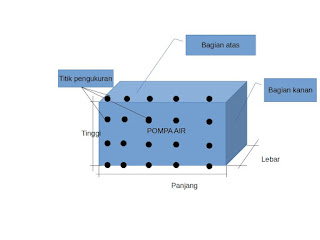
The noise measurement is carried out by first dividing the pump's dimensions into several parts, such as the top, right side, left side, and so on. Each part is then divided into a number of measurement points. At each point, the SPL can be measured three or more times, as shown in the figure.
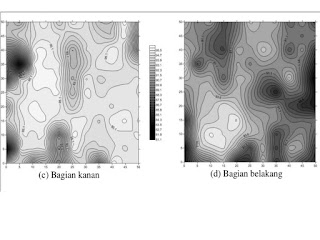
 
After the data obtained further spool water pump is made in the form of noise contour. Noise contours that have been completed can be seen in the following figure
 
From this noise contours then we can start designing a method for efficient and effective reduction shall we do to the water pump.

Post will later be followed by a simple experiment everyday materials that can be used to reduce the noise of the water pump.

thanks hopefully useful
 

Wednesday, February 24, 2016

Sound Wave Phenomena

Sound waves are disturbances that travel through an elastic medium, whether gaseous, liquid, or solid. A person receives sound vibrations through the eardrum within the frequency range of human hearing. These vibrations arise from variations in air pressure produced by a sound source and propagate into the surrounding medium, a region known as the acoustic field. When sound encounters a boundary of the medium through which it is traveling, the energy carried by the sound waves may be transmitted, absorbed, or reflected by that boundary. All three phenomena generally occur to varying degrees, depending on the nature of the boundary. The behavior of sound waves in terms of absorption, reflection, and transmission is illustrated in the figure.

Sound Absorption

Sound absorption refers to the conversion of sound energy into heat energy. A portion of the acoustic energy that enters a material is absorbed by its mass, which then transforms the acoustic energy into heat—this process is known as sound absorption. The ability of a material to absorb sound is typically measured by its sound absorption coefficient.

Several factors influence sound absorption, including material density, modulus of elasticity, moisture content, temperature, sound intensity and frequency, as well as surface conditions of the material. Materials with low density and low modulus of elasticity, combined with high moisture content and high temperature, tend to absorb more sound. The quality of a sound-damping material is indicated by its α value (sound absorption coefficient); the larger the α, the better the material performs as a sound absorber. The α value ranges from 0 to 1. If α = 0, no sound is absorbed. If α = 1, 100% of the incident sound is absorbed.

The amount of sound energy that is reflected, absorbed, or transmitted depends on the type and nature of the material. In general, porous materials absorb more sound energy than other material types. The presence of pores allows sound waves to penetrate into the material, where the absorbed sound energy is converted into other forms of energy—most commonly heat.

Absorber materials, reflective materials, and diffuser materials are the three main classes of acoustic materials. Common questions include: How do these materials respond when subjected to sound waves? How can a soundproof room be constructed? How can speech in a classroom be heard clearly?

To answer these questions, one must understand the behavior of a material when exposed to sound waves. For further details, refer to the following figure.


As illustrated in the figure, when a sound wave strikes a material, part of the wave is reflected, part is absorbed by the material, and part is transmitted through it. Acoustic materials are classified based on their dominant ability: reflecting sound waves, absorbing sound waves, or transmitting sound waves. A sound-absorbing material is one whose primary capability is to absorb sound waves. A soundproof material (or sound barrier) is one whose main function is to block the transmission of sound waves. Meanwhile, a sound diffuser material serves to spread the incoming sound waves in various directions; this typically requires a specific arrangement or modification to achieve the desired diffusion.

The ability of a sound-absorbing material to absorb sound waves is expressed by the sound absorption coefficient, which ranges from 0 to 1. A value of 0 means the material does not absorb any incoming sound energy, while a value of 1 means all incoming sound energy is absorbed. However, these extreme values are never found in actual acoustic absorbent materials.

The ability of a material to block sound energy from entering or leaving a room is expressed by the transmission loss (TL). This ability can also be represented by the Sound Transmission Class (STC). Selection of soundproofing materials is generally based on the STC value: the higher the STC value, the better the material is at blocking sound energy from entering or exiting a room.

A material's ability to absorb or block sound waves depends on the frequency of the incoming waves. Both absorbent materials and soundproofing materials perform well only at certain frequencies.

Thank you, and may this information be useful.


INTRODUCTION TO MECHANCAL VIBRATION


Vibration refers to the back-and-forth movement that occurs within a specific period of time. This phenomenon is closely related to the oscillatory motion of objects and the forces generated by that motion. Any object possessing mass and elasticity can vibrate; therefore, most machines and engineering structures experience some degree of vibration. As a result, engineering designs often need to take the nature of vibration into account.

1. Importance of Learning Mechanical Vibration

The primary goal of studying mechanical vibration is to minimize its harmful effects through improved machine design. Vibration problems are common in nearly all mechanical structures, often caused by mechanism imbalances. Examples of negative impacts include:

  • Mechanical failures resulting from material fatigue.

  • Accelerated wear and tear due to vibration.

  • In manufacturing processes, vibration can lead to rough surfaces on finished products.

Beyond these detrimental effects, vibration can also be harnessed for beneficial purposes, such as:

  • Use in vibrating conveyors, washing machines, and electric toothbrushes.

  • Application in pile driving and vibratory material testing.

  • Utilization to enhance efficiency in manufacturing processes like casting and forging.


2. Classification of Mechanical Vibration

Free Vibration

Free vibrations take place when a system oscillates as a result of internal forces acting within it, combined with the influence of a substantial external force. The system will then vibrate at its natural frequencies—one or more of them—which are properties established by the dynamic distribution of mass and elasticity. All systems with mass and elastic properties are capable of free vibration, occurring even without any external trigger.


Forced Vibration

Forced vibration refers to vibration that results from an external force acting on a system. When the external stimulus is oscillatory in nature, the system is compelled to vibrate at the frequency of that stimulus. If the frequency of the stimulus matches one of the system's natural frequencies, a resonance condition occurs, which may lead to dangerously large oscillations. Damage to large structures such as bridges, buildings, or aircraft wings is a frightening consequence of resonance. Therefore, determining the natural frequencies of a system is of primary importance.


A mechanical system experiences forced vibration whenever an external force acts on it while it is vibrating. This external excitation may come from an applied force or an imposed displacement. The excitation—whether force or displacement—can be harmonic, non-harmonic, non-periodic, or random. When the excitation force is harmonic, the system will respond with harmonic vibration as well.
For the response analysis 


  Free Body Diagram System


 Reference:
Rao, S. S. 2010. Mechanical Vibration Fifth Edition. Prentice Hall

Spectral Kurtosis untuk Getaran Robot: Memilih Band Fault Bearing dan Gearbox secara Cerdas

Ringkasan: Artikel ini membahas spectral kurtosis sebagai alat praktis untuk menemukan band frekuensi yang paling informatif saat mendiagn...